Flylib.com
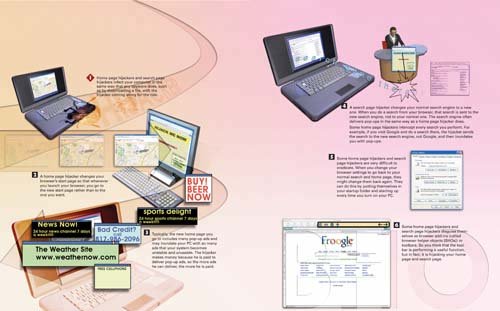
How Home Page and Search Page Hijackers Work
Previous page
Table of content
Next page
Previous page
Table of content
Next page
How Personal & Internet Security Works
ISBN: 0789735539
EAN: 2147483647
Year: 2004
Pages: 161
Authors:
Preston Gralla
BUY ON AMAZON
MySQL Stored Procedure Programming
What Is a Stored Program?
Creating Stored Functions
Execution Mode Options for Stored Programs
Cursors
Variables
OpenSSH: A Survival Guide for Secure Shell Handling (Version 1.0)
Step 4.3 How to Generate a Key Pair Using OpenSSH
Step 4.5 How to use OpenSSH Passphrase Agents
Step 4.6 How to use PuTTY Passphrase Agents
Step 5.2 Troubleshooting Common OpenSSH Errors/Problems
Appendix - Sample sshd_config File
Strategies for Information Technology Governance
A View on Knowledge Management: Utilizing a Balanced Scorecard Methodology for Analyzing Knowledge Metrics
Measuring ROI in E-Commerce Applications: Analysis to Action
Managing IT Functions
Governing Information Technology Through COBIT
The Evolution of IT Governance at NB Power
Lotus Notes and Domino 6 Development (2nd Edition)
Working with the Properties Box
Creating Shared Applets
Writing View Formulas
JavaScript Support in Domino 6
Creating Workflow Applications
Building Web Applications with UML (2nd Edition)
Activities
The Use Case Model
Discussion
HTML Frames
Advanced Client-Side Scripting
Telecommunications Essentials, Second Edition: The Complete Global Source (2nd Edition)
Multiplexing
The PSTN Infrastructure
IPT
Cable TV Networks
4G: Wireless Broadband
flylib.com © 2008-2017.
If you may any questions please contact us: flylib@qtcs.net
Privacy policy
This website uses cookies. Click
here
to find out more.
Accept cookies