Appendix P Project Statement of Work
OVERVIEW
System Release # Project # CI #
VERSION: Draft
Project Statement of Work
Project Manager: < name >
Created:
Last Updated:
Created By:
PROJECT INFORMATION
Project Request
This project has been requested to provide various Business Lines new and/or improved functionality within the System. Some of the requested changes will be beneficial for the customer also.
Project Number and Title
This project will be referred to as the "?? Project." The project number is ??.
Executive Sponsor or Delegate
The Business Group Head for this project is of and the executive sponsor is , Group Technology Executive.
PROJECT DEFINITION
Background
There are several requirements requested for Release ??. These requirements will be funded by various Business Lines and will benefit several different areas as well as the customer in many cases.
Release ?? is one of two remaining releases scheduled for by the enterprise. The planned implementation date for Release ?? is . This release will be coordinated with the scheduled between and .
Project Objectives
To provide more functionality and data accessibility in the ?? System to the Business Lines and the customer in the least amount of time for the most reasonable cost.
Business Units Involved
Internal
Impacts to the following applications were determined in the initial data gathering phase of this project. Certain applications have been defaulted to testing only as no response was obtained during the data gathering phase. Formal sizing has been gathered from all impacted applications as a part of the requirements phase of this project. This list represents the internal interfaces.
Internal Applications/Areas: Impacts:
- Application name: No development set-up and testing needed
- Application name: Application name Development, testing needed
- Application name Development
- Application name Testing needed
- Application name: Development, testing needed
- Sub-system name Testing needed
- Sub-system name No development; set-up, and testing needed
- Sub-system name Testing needed
External
The external organizations impacted by this project include:
- Third-Party Package name: New process and procedures; development, testing needed
Business Impacts
This project will have the following business impacts:
- Changes for all customers
- Changes for Wholesale Sales and Relationship Managers
- Changes for Regional Managers
- Changes for Operations
- Changes for Central Implementation and Regional Implementation Centers
Business Benefits
This project will have the following business benefits:
- Improved presentation of customer statements and reports
- Productivity gains on automating various processes
- Productivity gains on making specific data more readily available to analysts for problem resolution
- Compliance with Corporate branding standards
Risks
Risk Rating
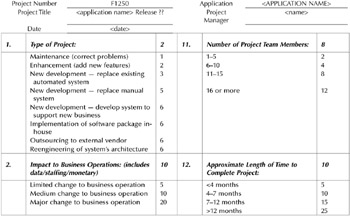
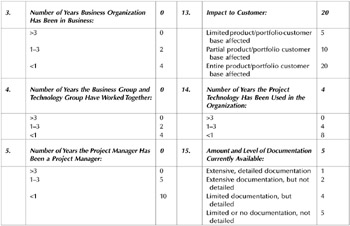
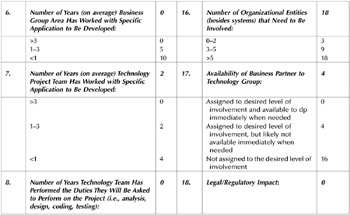
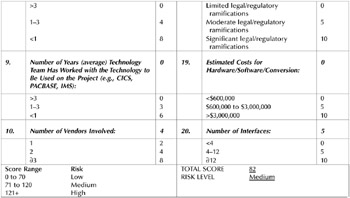
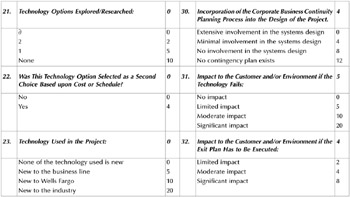
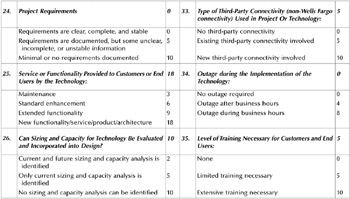
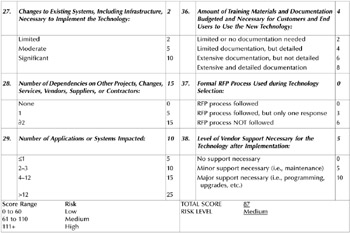
The risk score for this project is 82. As a result of the risk rating, this project has been rated as a medium-risk project. There is additional risk due to some of the requested changes to be implemented in conjunction with the release implementation date. There is a conflict between the release date and the upgrade date.
See Appendix P2: Risk Assessment form.
Identified Risks
The risks identified for this project include the following:
- Late deliverables if resource constraints
- Resource constraints if work needed on other higher priorities such as production issues
- Retaining key project team resources
- Conflicting project priorities
- Communication, coordination, and task management of all impacted/affected applications are necessary for successful implementation
- Risk of impacted customers due to the complexity of some changes
Risk Mitigation
The following actions will be taken to address the identified risks:
- Hire contractors as necessary to assist the team in completing the assigned tasks .
- Work with the Business Lines early in the requirements gathering phase to document detailed requirements.
- More accurate estimates due to detailed business requirements.
- Regularly scheduled meetings will be held to keep all impacted/affected applications up-to-date on tasks.
- Include adequate checkpoint reviews in the project process to ensure accurate and complete information.
- Testing will be coordinated with all impacted applications to ensure the changes are correct.
PROPOSED SOLUTION
Current
Not all functionality was built into the new System from the old System. This lack of functionality is causing many manual work-arounds and in some cases loss of revenue. Some of the requested changes also position in compliance with strategic standards.
Proposed Solution
The management team is working with the Project Manager to ensure that detailed Business Requirements are fully documented and to prioritize those requirements based on business need. Those requirements have been sized and presented to the various Business Lines. A resource plan will be updated to reflect the number of resources available during the Release ?? timeframe. The Business Lines will then obtain funding for the requirements that can be completed in that Release ?? timeframe.
The project plan will be updated and an issues log and task plan will be maintained throughout the term of the project.
PROJECT SCOPE
Inclusions
The scope of this project includes the following:
- Defining and communicating the business requirements to all affected applications that are included in the Release ?? requirements
- Assessing and managing the impacts to the various Operational/Support Groups/Business Lines
- Participation in development of customer, department, and vendor communications
- Participation in development of customer or internal training
- Participation in development of user documentation and procedures
- Participation in regression testing
- Validation of requirements, design, development, and unit and system testing of application changes necessary to the applications listed in the Business Units Involved
- Changes needed for other applications requirements
A list of the requirements scheduled for Release ?? is attached as Appendix P6.
Exclusions
The scope of this project does not include the following:
- Any non- accounts
- (??) application conversion (although it is a dependency)
Security Statement
- The Security Plan is prepared to ensure that appropriate controls are being designed that meet security policy and standards. The plan should identify risks and exposures to information, systems, and networks that may result from any exceptions to the standards. The System Managers are responsible for ensuring that the security plans are updated or created for all systems.
PROJECT APPROACH
Project Management
has been assigned to manage the project. The responsibilities of the project manager will be:
- Establish and execute a project plan
- Ensure completion of project estimates, as required
- Track actual costs against budget/planned costs
- To assist in maintaining the overall project direction
- First point of escalation of project issues
- Obtain project resource commitments
- Define project milestones
- Create and maintain a project issues log
- Schedule and conduct project status meetings
- Complete project status meeting minutes
- Complete project status reports
- Contact lists for all project participants with defined roles and responsibilities
- Ensure detailed test plans are complete
- Participate in the post-event review
- Communicate with the other End-to-End Project Managers
- Close the project
Methodology
This project will follow the methodology.
One overall project manager will be assigned as the end-to-end project manager as well as the Technical Lead. This project manager will manage the details of the System development efforts. The project manager will maintain a common format for issues, project plans, and technical requirements. The project manager will provide day-to-day management for the technical team and provide a roll-up of all issues, plans, and requirements.
Deliverables
Key Project Deliverables
Key deliverables from this project include:
- Statement of Work
- Risk Assessment
- Project Change Requests
- Project Requirements Document
- Design Documents
- Communication Plan
- Data Security Plan
- Resource Plan
- Critical Success Factors Document
- Master Test Plan
- Training Plan
- Implementation Plan
- Post-Implementation Review
Approvals
Approval of key project deliverables must be received from the following individuals:
- A = Approval Required; R = Review Only
|
Area |
Deliverables |
||||||||||||
|---|---|---|---|---|---|---|---|---|---|---|---|---|---|
|
1 |
2 |
3 |
4 |
5 |
6 |
7 |
8 |
9 |
10 |
11 |
12 |
13 |
|
|
Operations Manager |
A |
A |
A |
A |
A |
A |
R |
A |
A |
A |
A |
A |
A |
|
Technical Manager |
A |
A |
A |
A |
A |
A |
R |
A |
A |
R |
R |
A |
A |
|
TM Product Manager |
A |
A |
A |
A |
A |
A |
A |
A |
A |
A |
A |
R |
A |
|
Operations Manager |
A |
A |
A |
A |
A |
A |
R |
A |
A |
A |
A |
A |
A |
|
Project Manager |
A |
A |
A |
A |
A |
A |
R |
A |
A |
A |
R |
A |
A |
|
Wholesale Services |
A |
A |
A |
A |
A |
A |
R |
A |
A |
R |
A |
R |
A |
|
Wholesale Integration |
A |
A |
A |
A |
A |
A |
R |
A |
A |
A |
A |
R |
A |
|
Audit Representative |
R |
R |
R |
R |
R |
R |
R |
R |
R |
R |
R |
R |
R |
Acceptance Criteria
This project will be considered completed when the following acceptance criteria have been met:
- Each system change has passed all levels of test successfully and is implemented into production successfully.
- Delivered system functionality meets agreed-upon functionality
- There is no undue fallout up to two weeks after implementation.
Assumptions
The following assumptions are being made for this project:
- Resources assumption. The key resource assumptions for labor, space, and equipment are:
- Technical Lead will be identified and assigned
- A test coordination leader is identified and assigned for .
- Testing Assumptions in general:
- Test coordination with all affected applications will be managed by an assigned resource from testing. Other testing resources will be drawn from each of the applications.
- Testing by all affected applications will be conducted at the specified time established by Release Management for this release.
- All Business Line resources are available to the overall project.
- Project support resources are available to the overall project.
- Production support has the highest priority for resources. Other resource issues will be addressed and prioritized at the Steering Committee Meeting level.
- The Release ?? key dates will not be changed and the various phases of the project will start and end on time.
Key Facts
Key facts identified for this project include the following:
- If the ?? requirement is not implemented with this release, we will continue to lose revenue at the rate of approximately $?? a month.
- If the new statement paper and logo requirement is not implemented with this release, will continue to be out of compliance with enterprise standards.
- If is not implemented with this release, there will be staffing impacts to the Operations group .
- All and related changes must be implemented concurrently.
- If is not implemented, there will be customer and Operational impacts.
- If the file format changes are not made, there will be customer impacts.
- If the changes are not made, there will be customer impact.
Issue Management
Project-related issues will be tracked, prioritized, assigned, resolved, and communicated as follows :
- The project manager and participants will report issues that are identified throughout the life of the project.
- The project manager will maintain a log of all issues and report on the status of issues.
- The project manager will assign the priority and ownership to the issue. If necessary, the Executive Sponsors will assist the project manager in assigning appropriate ownership for resolution.
- Individual team members assigned to resolve the issue will be responsible for communicating the issue status to the project manager.
See Appendix P5 for the Issue Log template.
Change Management
A change management procedure will be used by this project to help ensure that changes impacting the project are assessed, understood , and agreed upon by stakeholders before the change is made or before initiating specific actions to accommodate the change. The purpose of this procedure is to control change and impacts to the project and not to discourage change.
A Project Change Request form (PCR) must be submitted to the Project Manager for any changes that impact the project's cost, schedule, or scope. The Project Manager will review the proposed change request with the project team members impacted by the change to assess the impact of the change. The Project Manager will present the change request to the Steering Committee to approve or reject the request. The decision will be communicated to the requester and project team.
See Appendix P4 for the Project Change Request form and instructions.
Communication Plan
A project communication plan will be completed. This plan identifies the approach that will be used to share information with key internal and external parties throughout the project. The key elements of the communication plan include:
- Who must receive the information
- What intervals the information will be shared
- Who will provide the information
- What medium will be used
Project Status
The status of this project will be communicated in multiple ways. These include:
- Weekly project team status meeting
- Weekly project management status meeting
- Monthly project status reporting to the business lines
- Monthly online project status reporting to the PMO
- Project Plan Updates
A meeting agenda will be published prior to the meetings so participants can be prepared for the meeting. Meeting minutes will be distributed after the meeting has occurred so the team is aware of the discussion at the meeting.
PROJECT SCHEDULE AND MAJOR MILESTONES
|
Milestone |
Start Date |
Completion Date |
|---|---|---|
|
Requirements |
||
|
Analysis |
||
|
Design |
||
|
Development |
||
|
Testing |
||
|
Implementation |
||
|
Post-Implementation Support |
||
|
Project Closure |
Project Team
Project Organization (Shaded Boxes in Figure P1 are the Core Management Project Team)
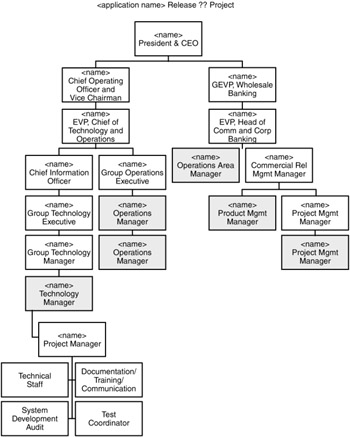
Figure P1: Project Organizational Chart
Project Team Roles Responsibilities
|
Area |
Individual(s) |
Role/Responsibilities |
|---|---|---|
|
Project Manager |
< name > |
First point of escalation of project issues Obtain project resource commitments Complete project estimates, as required Establish and execute a project plan Define project milestones Create and maintain a project issues log Schedule and conduct project status meetings Complete project status meeting minutes Compete project status reports Monitor and manage financial status of project Participate in the post-implementation review meeting Communicate with the other End-to-End Project Managers Close the project |
|
Technical Lead |
Review and approve Change Requests Create Systems project plan Participate in weekly project status meetings Conduct system training, as needed Conduct system status meetings Assist in User Acceptance Testing Ensure System Testing is completed Complete the Technical Design and Review Review and approve the project plan Develop the systems support plan Develop system conversion programs, as needed Complete system development and unit testing Update system documentation Complete production support plan Ensure technical activities are included in the project timeline Ensure technical resources are available to complete technical activities |
|
|
Technical Systems Manager |
Review and approve business requirements Approve project plan Review and approve Change Requests Review and approve project plan Review and approve User Design Review test plans Review and approve the project implementation plan Review and approve the support plan |
|
|
Product Management Project Lead |
Complete Product research and analysis Review product implementation workflow Define business requirements Approve project plan Review and approve Change Requests Review and approve project plan Communicate product changes and delivery plan to project team and line staff Review and approve User Design Perform gap analysis of old product versus new product Review and approve customer transition workflow Complete Product risk assessment Define product pricing structure Review test plans Resolve Product issues Assist with development of customer communications Review the project implementation plan Review and approve the support plan |
|
|
Operations Project Leader |
Review and approve Change Requests Create Operations project plan Participate in weekly project status meetings Conduct operations team status meetings, as necessary Participate in User Acceptance Testing Train Operations staff, as needed Provide Operations requirements Review and approve the Technical Design Review and approve User Design Review and approve the project plan Update Operations documentation Develop the operations support plan Review the project implementation plan Review and approve the support plan Ensure Operations resources are available to complete operation activities |
|
|
Customer Services Project Leader |
Review and approve Change Requests Participate in weekly project status meetings Participate in User Acceptance Testing Train Customer Services staff, as needed Provide Customer Service requirements Review and approve the Technical Design Review and approve User Design Review and approve the project plan Update Customer Service documentation Review the project implementation plan Review and approve the support plan Ensure Customer Services resources are available to complete customer service activities |
|
|
Integration Project Leader |
Review and approve Change Requests Participate in weekly project status meetings Participate in User Acceptance Testing Train Implementation staff, as needed Provide implementation requirements Review and approve the Technical Design Review and approve User Design Review and approve the project plan Update implementation documentation Review the project implementation plan Review and approve the support plan Ensure implementation resources are available to complete implementation activities |
|
|
Documentation and Training |
Coordinate with various bank training groups to ensure the proper updates are made to documentation, and to assess the need for training |
|
|
Test Coordination |
Identification of testing participants , organization of test team, and definition of responsibilities Coordinate cross-project testing dependencies with other testing project leads Identification of business/operation end users that may need to validate Confirm testing environment provided will meet needs Schedule testing with dependencies based on design, training, and conversion schedule Completion of test plan and approval Completion of test scripts and approval Establish and communicate testing schedule Communicate testing status with project team Monitoring of test cycles Ensure validation complete Track testing issues for fixes to be made and ensure appropriate resolution Obtain testing sign-offs Types of testing to manage for CTG: IAT (Integrated Application Testing) UAT (User Acceptance Testing) |
PROJECT ESTIMATES COSTS
Project Estimates and Costs
|
Description |
Dollars |
|
|---|---|---|
|
Capital (hardware/software) |
(if applicable ) |
N/A |
|
Labor costs |
||
|
# hours |
$ |
|
# hours |
$ |
|
hours |
$ |
|
Test CPU |
(if applicable) |
N/A |
|
Test DASD |
(if applicable) |
N/A |
|
* Other (list all) |
Travel/training |
$ |
|
Depreciation |
N/A |
|
|
Software |
N/A |
|
|
Teleconference |
$ not budgeted |
|
|
Training |
N/A |
|
|
Total dollars |
Total *$ |
|
|
*Ball Park Estimate |
Research and Experimentation Tax Credit Eligibility
An evaluation was completed for this project to determine if the project qualifies as an eligible R & E activity. The result of the evaluation indicates that this project does not qualify as an eligible R & E activity.
See Appendix P3 for the completed R & E Tax Credit evaluation.
APPENDICES
Appendix P1 Statement of Work Approval
|
Project Number |
?? |
|
Project Name |
Release ?? Project |
|
Phase Name |
Design |
AUTHORIZATION
|
Name |
Signature |
Approval Date |
|---|---|---|
|
Operations Manager |
||
|
Technology Manager |
||
|
Project Manager |
||
|
Treasury Management |
||
|
Product Management |
||
|
Operations Manager |
||
|
Client Services |
||
|
Wholesale Integration |
Appendix P2 Support Documentation Risk Assessment Form
Appendix P3 Potential Tax Credit Tests
The following analysis evaluates if this project qualifies as an eligible R & E activity.
|
Yes |
No |
Qualification Tests |
||
|---|---|---|---|---|
|
q |
½ |
First Test Do the activities qualify as research in the laboratory or experimental sense by: Relating to, or supporting, the development or improvement of a product; and Intending to discover information that would eliminate uncertainty concerning the development or improvement of a product or process? |
||
|
½ |
q |
Second Test Is the research undertaken for the purpose of discovering information that is technological in nature? |
||
|
½ |
q |
Third Test Do the activities undertaken include the elements of the process of experimentation (i.e., were alternative designs evaluated using the scientific method or did the development of the final design require experimentation)? |
||
|
½ |
q |
Fourth Test Is the activity being conducted for a permitted purpose: new or improved function, performance, reliability, quality, or significant cost reduction? If software is developed for internal management function and technique it generally does not qualify for tax credit unless it meets the following three-part test : |
||
|
Yes |
No |
|||
|
q |
½ |
First Test Is the software innovative in that it results in a reduction of costs or improvement in speed that is substantial and economically significant? |
||
|
q |
½ |
Second Test Does the development involve significant economic risk in that the company commits substantial resources to the development and there is substantial uncertainty, because of technical risk, that such resources would not be recovered in a reasonable period? |
||
|
q |
½ |
Third Test Is the software being developed not commercially available (i.e., can the software be obtained elsewhere and used for the intended purpose without modifications that would satisfy the first and second tests above)? |
||
Appendix P4 Change Management Form and Instructions
Procedure
At the conclusion of the requirement phase of the project, the requirements will be considered static and unchangeable because they will form the basis for subsequent project activities. In the event that a change is necessary, the following process must be followed to ensure that the change is implemented into the project plan and impacts are adequately assessed.
- A change is identified as a result of an issue or of some change to the project environment (for example, regulatory and/or competitive changes).
- The person who is requesting the change completes a Project Change Request Form and sends it to the Project Manager. This form will require the following information from the requester(s):
- Date of the Request ” this is the date the request form is filled out.
- Requester ” the name of the individual requesting the change.
- Description of Change ” a detailed description of the requested change.
- Business Reason for Change ” a detailed description of the business reason why the change must be implemented as part of this project.
- The Project Manager will review the change request with all impacted team members to determine the project tasks that will either be added or impacted by the change request and estimate the impacts of the change.
- After assessing the impact of the requested change on the project and completing estimated cost and schedule impacts, the request will be presented to the Executive Sponsors and either approved or denied .
- The Project Manager will contact the requester by sending a completed change request form to the requester with the final decision and inform the impacted areas of the decision. If the change request is denied, the Project Manager will include a reason for denial in the Reason for Denial section.
- A copy of the Project Change Request Form will be included in the project file for permanent record and the project task plan will be updated accordingly .
Project Change Request Form
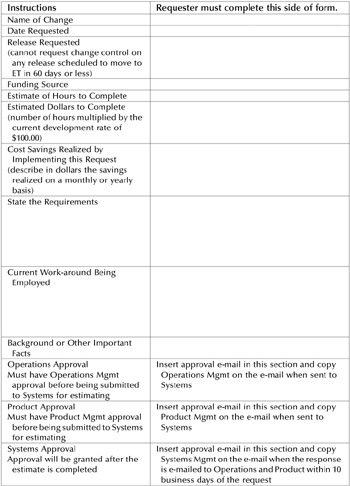
Release ?? Change Control Request Form
Procedure:
- Complete the Change Control Form.
- Submit to Application Systems Manager or Team Lead.
- Systems will estimate the effort.
- Systems will respond within 10 business days indicating if the change can be absorbed in the release requested:
- If the request can be absorbed, work will be queued as appropriate.
- If the request cannot be absorbed, the Systems group will call a meeting to discuss reprioritizing requirements or moving the request to another release.
- See bottom of form for Approval Instructions.
Appendix P5 Issues Log
Release ?? Issues Log
|
Issue # |
Open Date |
Opened By |
Issue Description |
Assigned To |
Due Date |
Closed Date |
Status |
Priority |
Comments/ Resolution |
|---|---|---|---|---|---|---|---|---|---|
|
OPEN ISSUES |
|||||||||
|
Issue # |
Open Date |
Opened By |
Issue Description |
Assigned To |
Due Date |
Closed Date |
Status |
Priority |
Comments/ Resolution |
|---|---|---|---|---|---|---|---|---|---|
|
CLOSED ISSUES |
|||||||||
|
Priority Codes: |
Status Codes: |
||||||||
|
High = Show Stopper - cannot continue without issue resolution. |
(A)ctive |
||||||||
|
Medium = Caution - may continue without immediate resolution. |
(R)esolved |
||||||||
|
Low = Not Critical - can continue without issue resolution. |
(D)eferred |
||||||||
|
(P)ending |
|||||||||
Appendix P6 List of Requirements Scheduled for Release ??
- New File Format
- New File Format
- New Stmt Paper and Logo
Preface
- Introduction to Software Configuration Management
- Project Management in a CM Environment
- The DoD CM Process Model
- Configuration Identification
- Configuration Control
- Configuration Status Accounting
- A Practical Approach to Documentation and Configuration Status Accounting
- Configuration Verification and Audit
- A Practical Approach to Configuration Verification and Audit
- Configuration Management and Data Management
- Configuration Change Management
- Configuration Management and Software Engineering Standards Reference
- Metrics and Configuration Management Reference
- CM Automation
- Appendix A Project Plan
- Appendix C Sample Data Dictionary
- Appendix D Problem Change Report
- Appendix E Test Plan
- Appendix G Sample Inspection Plan
- Appendix I System Service Request
- Appendix J Document Change Request (DCR)
- Appendix K Problem/Change Report
- Appendix L Software Requirements Changes
- Appendix M Problem Report (PR)
- Appendix N Corrective Action Processing (CAP)
- Appendix P Project Statement of Work
- Appendix Q Problem Trouble Report (PTR)
- Appendix S Sample Maintenance Plan
- Appendix T Software Configuration Management Plan (SCMP)
- Appendix U Acronyms and Glossary
- Appendix V Functional Configuration Audit (FCA) Checklist
- Appendix W Physical Configuration Audit (PCA) Checklist
- Appendix X SCM Guidance for Achieving the Repeatable Level on the Software
- Appendix Y Supplier CM Market Analysis Questionnaire

EAN: 2147483647
Pages: 235
