Network Media
| Whatever type of network is used, some type of network media is needed to carry signals between computers. Two types of media are used in networks: cable-based media, such as twisted pair, and the media types associated with wireless networking, such as radio waves. In networks using cable-based media, there are three basic choices:
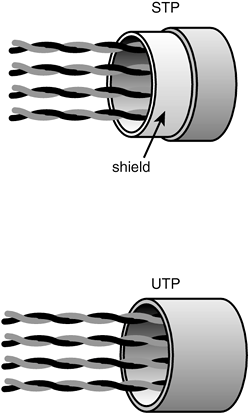
Twisted-pair and coaxial cables both use copper wire to conduct the signals electronically; fiber-optic cable uses a glass or plastic conductor and transmits the signals as light. For many years, coaxial was the cable of choice for most LANs. Today, however (and for the past 10 years), twisted pair has proved to be far and away the cable media of choice, thus retiring coax to the confines of storage closets. Fiber-optic cable has also seen its popularity rise butbecause of costhas been primarily restricted to use as a network backbone where segment length and higher speeds are needed. That said, fiber is now increasingly common in server room environments as a server to switch connection method, and in building to building connections in what are termed as metropolitan area networks (MANs). The following sections summarize the characteristics of each of these cable types. Twisted-pair CablingTwisted-pair cabling has been around a very long time. It was originally created for voice transmissions and has been widely used for telephone communication. Today, in addition to telephone communication, twisted pair is the most widely used media for networking. The popularity of twisted pair can be attributed to the fact that it is lighter, more flexible, and easier to install than coaxial or fiber-optic cable. It is also cheaper than other media alternatives and can achieve greater speeds than its coaxial competition. These factors make twisted pair the ideal solution for most network environments. Two main types of twisted-pair cabling are in use today: Unshielded Twisted Pair (UTP) and Shielded Twisted Pair (STP). UTP is significantly more commonplace than STP and is used for most networks. Shielded twisted pair is used in environments in which greater resistance to EMI and attenuation is required. The greater resistance comes at a price, however. The additional shielding, plus the need to ground that shield (which requires special connectors), can significantly add to the cost of a cable installation of STP.
STP provides the extra shielding by using an insulating material that is wrapped around the wires within the cable. This extra protection increases the distances that data signals can travel over STP but also increases the cost of the cabling. Figure 2.1 shows STP and UTP cabling. Figure 2.1. STP and UTP cabling. (Reproduced with permission from Computer Desktop Encyclopedia.© 1981-2005 The Computer Language Company Inc. All rights reserved.)
There are several categories of twisted-pair cabling, with the early categories most commonly associated with voice transmissions. The categories are specified by the Electronics Industries Association/Telecommunications Industries Association (EIA/TIA). Table 2.1 shows the categories along with the speeds that they are used to support in common network implementations.
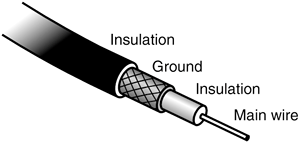
CoaxialCoaxial cable, or coax as it is commonly referred to, has been around for a long time. Coax found success in both TV signal transmission as well as in network implementations. Coax is constructed with a copper core at the center that carries the signal, plastic insulation, braided metal shielding, and an outer plastic covering. Coaxial cable is constructed in this way to add resistance to attenuation (the loss of signal strength as it travels over distance), crosstalk (the degradation of a signal caused by signals from other cables running close to it), and EMI (electromagnetic interference). Figure 2.2 shows the construction of coaxial cabling. Figure 2.2. Coaxial cabling.
Networks can use two types of coaxial cabling: thin coaxial and thick coaxial. Both have fallen out of favor, but you might still encounter thin coax in your travels. Thin CoaxThin coax is much more likely to be seen than thick coax in today's networks, but it isn't common, either. Thin coax is only .25 inches in diameter, making it fairly easy to install. Unfortunately, one of the disadvantages of all thin coax types are that they are prone to cable breaks, which increase the difficulty when installing and troubleshooting coaxial-based networks. There are several types of thin coax cable, each of which has a specific use. Table 2.2 summarizes the categories of thin coax.
Fiber-optic CableIn many ways, fiber-optic media addresses the shortcomings associated with copper-based media. Because fiber-based media use light transmissions instead of electronic pulses, threats such as EMI, crosstalk, and attenuation become a nonissue. Fiber is well suited for the transfer of data, video, and voice transmissions. In addition, fiber-optic is the most secure of all cable media. Anyone trying to access data signals on a fiber-optic cable must physically tap into the media. Given the composition of the cable, this is a particularly difficult task. Unfortunately, despite the advantages of fiber-based media over copper, it still does not enjoy the popularity of twisted-pair cabling. The moderately difficult installation and maintenance procedures of fiber often require skilled technicians with specialized tools. Furthermore, the cost of a fiber-based solution limits the number of organizations that can afford to implement it. Another sometimes hidden drawback of implementing a fiber solution is the cost of retrofitting existing network equipment. Fiber is incompatible with most electronic network equipment. This means that you have to purchase fiber-compatible network hardware.
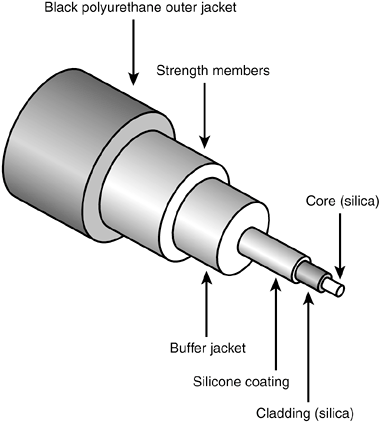
Fiber-optic cable itself is composed of a core glass fiber surrounded by cladding. An insulated covering then surrounds both of these within an outer protective sheath. Figure 2.3 shows the composition of a fiber-optic cable. Figure 2.3. Fiber-optic cable.
Two types of fiber-optic cable are available: single and multimode fiber. In multimode fiber, many beams of light travel through the cable bouncing off of the cable walls. This strategy actually weakens the signal, reducing the length and speed the data signal can travel. Single-mode fiber uses a single direct beam of light, thus allowing for greater distances and increased transfer speeds. Some of the common types of fiber-optic cable include the following:
In the ever-increasing search for bandwidth that will keep pace with the demands of modern applications, fiber-optic cables are sure to play a key role.
|